
Every car has a story, and its Vehicle Identification Number (VIN) tells it. This unique 17-character code is essentially your car's fingerprint — a permanent identifier that follows it from the factory floor to the scrap yard. It's far more than a random serial number; it's the single most important piece of information tied to your vehicle.
Your Car's Unique Fingerprint
Think of a VIN as the DNA of your car. It's the key to almost every official process — registration, insurance, and getting an accurate quote for your scrap car in Adelaide. Every Australian motor vehicle is assigned a 17-character VIN that aligns with international standards, and it's physically stamped onto the chassis, making it a permanent part of the car's identity. In fact, by early 2024, there were over 15.3 million passenger vehicles registered across the country, each one tracked by its VIN.
Why this code matters
- Verifying ownership — the ultimate proof of who legally owns the car.
- Checking history — reveals past accidents, major repairs, or outstanding recalls.
- Preventing theft — law enforcement uses it to identify and recover stolen vehicles.
- Ensuring accuracy — mechanics and parts suppliers use it to find the exact parts for your model.
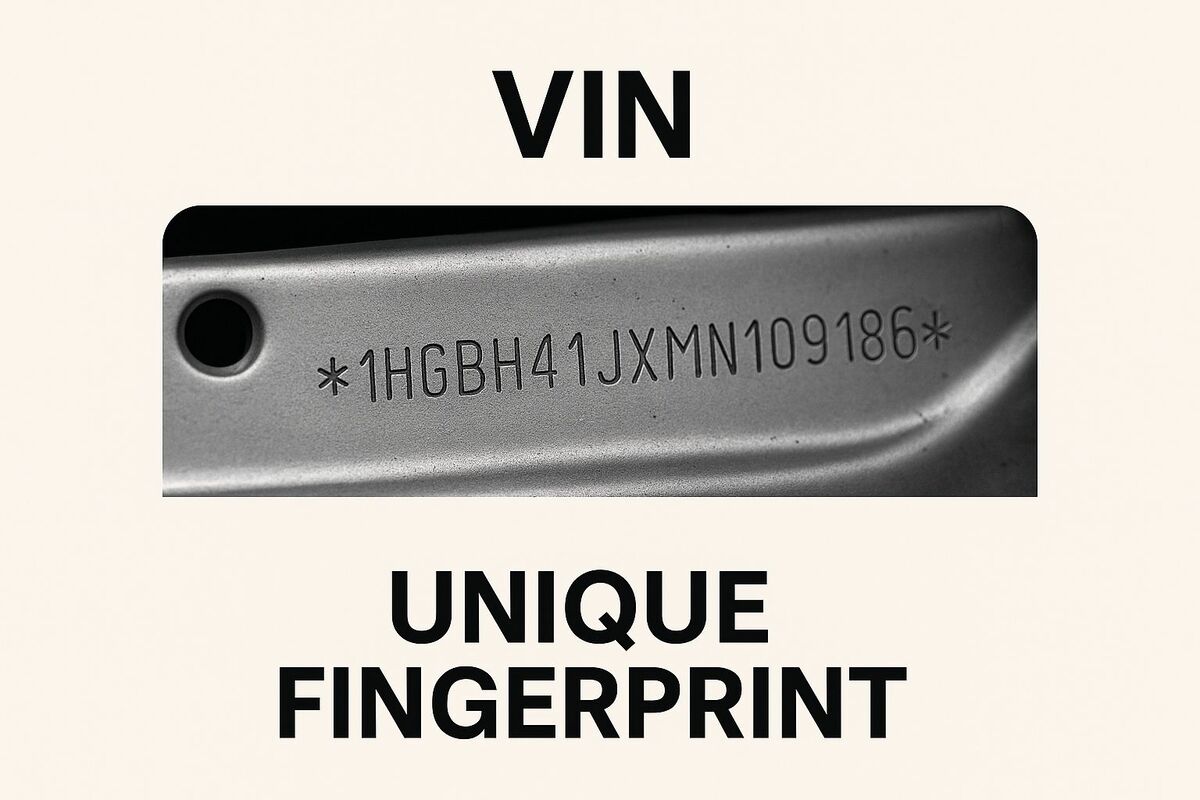
How to Decode a VIN Character by Character
World Manufacturer Identifier (WMI)
The first three characters tell you where the vehicle was made and which company built it. Character 1 is the country of origin (a 'J' points to Japan, a 'W' to Germany); characters 2–3 pinpoint the specific manufacturer.
Vehicle Descriptor Section (VDS)
Characters four to nine describe the vehicle's model, body style, and engine type. The ninth character is a "check digit" — a security feature that confirms the VIN is authentic and hasn't been tampered with.
Vehicle Identifier Section (VIS)
Characters 10 to 17 give your car its unique serial number. Character 10 indicates the model year, character 11 the manufacturing plant, and characters 12–17 the unique sequential serial number.
Why We Needed a Standard VIN
Before the modern system, every manufacturer stamped cars with serial numbers that varied in length and format, making it nearly impossible to track history or ownership — a golden opportunity for criminals. In the early 1980s, manufacturers and regulators adopted the unified 17-character VIN, guaranteeing no two cars share the same VIN and giving every vehicle a traceable fingerprint.
The VIN's Role in Australian Vehicle Management
The VIN links every car to a central database called the National Exchange of Vehicle and Driver Information System (NEVDIS) — the official historian for every vehicle in the country. It underpins:
- Registration and title transfers — confirming the vehicle is what it claims to be and isn't stolen.
- Insurance claims — verifying exact details and helping stamp out fraud.
- Safety recalls — tracking specific affected vehicles so owners are notified.
- Compliance checks — ensuring vehicles meet Australian Design Rules.
Using a VIN to Sell Your Scrap Car in Adelaide
When you reach out to a car removal service, the VIN is one of the first things they'll ask for — it's the single most important piece of info for a fair, accurate quote, letting a wrecker instantly confirm the exact make, model, year, and engine. It also lets them:
- Verify legal ownership — confirm you're the rightful owner.
- Check for encumbrances — reveal any finance owing or theft report.
- Provide an accurate quote — details like engine size directly affect the value.
Common VIN Myths and Misconceptions
A VIN report only shows what's been officially recorded — a small prang fixed for cash may never appear. Free VIN decoders are great for the basics (make, model, year), but detailed title history needs a comprehensive report.
A persistent myth is that a VIN is linked to your personal details. This is completely false — a VIN is the car's story, not the owner's. Your name and address are never embedded in it.
Practical Questions About VINs
Where can I find my car's VIN?
On the dashboard (driver's side, where it meets the windscreen), the driver's door jamb (B-pillar sticker), and on your registration certificate and insurance documents.
Can two cars have the same VIN?
No — a VIN is unique, designed so no two vehicles made within a 30-year window can ever share the same number.
What if the VIN on the car and paperwork don't match?
Stop everything — a mismatched VIN is a massive red flag that could indicate a stolen or "cloned" vehicle. Don't buy until the discrepancy is officially investigated and resolved.
We offer competitive cash prices with on-the-spot payment and free towing anywhere in Adelaide.